Web Application Pentesting

Web Application Pentesting That Finds What Actually Matters

Senior-led testing for product and engineering teams that need to understand what can actually be exploited, what matters most, and what to fix first.


What people say about us

Misaligned Scope

Slow Communication

Generic Reporting

Missed Business Logic

Static Output

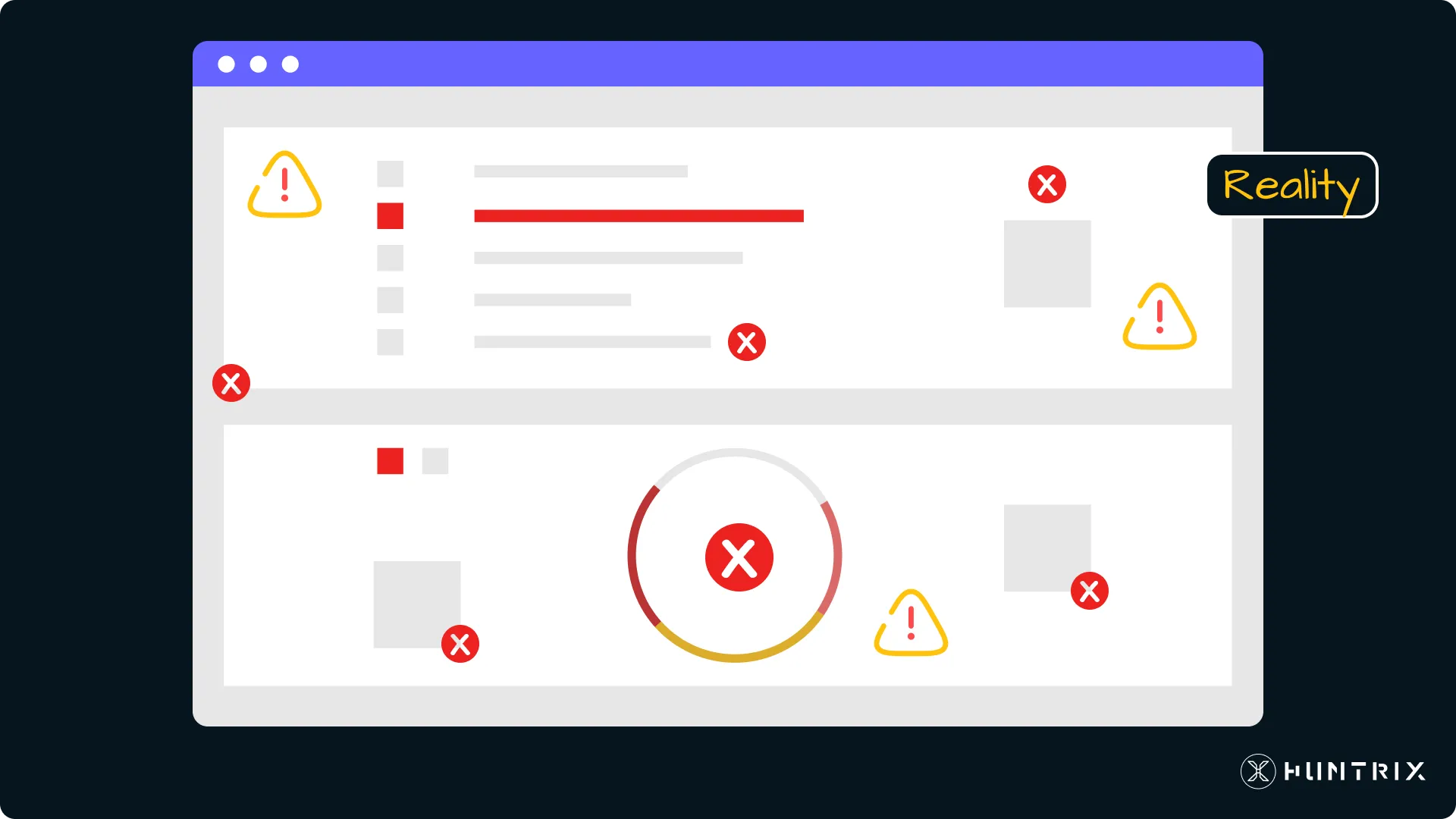
Bad Testing Teams Create Complexity

A strong web application pentest should make risk clearer.

The complexity usually comes from somewhere else: unrealistic sales promises, weak scoping, offshore handoffs, generic reports, delayed communication, and testing teams that do not understand how modern products are built.

Signal

What Happens

Impact

Misaligned Scope

The sales process promises depth the delivery team is not equipped or staffed to provide.

Your team spends more time clarifying expectations than reducing risk.

Slow Communication

Questions sit unanswered, context gets lost, and offshore or layered delivery teams create delays.

Testing slows down, engineers lose momentum, and fixes get pushed later than they should.

Generic Reporting

Findings are written like checklist items instead of being tied to your application, workflows, users, and business model.

Your team has to translate the report into actual engineering decisions.

Missed Business Logic

Testers focus on common vulnerability classes but miss abuse cases specific to how your product works.

The issues most likely to affect customers, revenue, trust, or sensitive workflows can remain undiscovered.

Static Output

Findings are delivered as a PDF with limited support for tracking, ownership, retesting, or closure.

Vulnerabilities become documentation instead of actionable work your team can resolve and verify.

What Strong Testing Gives Your Team

Risk clarity

Understand which vulnerabilities are exploitable, which are theoretical, and which deserve immediate attention.

Engineering focus

Give developers clear, prioritized remediation guidance instead of vague recommendations.

Business context

Tie findings to customer data, revenue impact, compliance exposure, product workflows, and trust.

Cleaner communication

Work directly with senior testers who can explain the issue, answer questions, and help move the work forward.

Resolution tracking

Move findings into Jira, Notion, ServiceNow, or another workflow your team already uses.

Built for Teams With Real Products, Real Users, and Real Risk

Product and engineering leaders responsible for customer-facing applications

SaaS companies preparing for customer security reviews

Companies preparing for SOC 2, ISO 27001, PCI, HIPAA, or customer assurance requests

Mid-market teams that need third-party validation

Enterprise teams that want senior testing without large-consultancy drag

What We Test

Web Application Security, Tested Like a Real Product

Software Supply Chain Failures

Cryptographic Failures

Insecure Design

Software or Data Integrity Failures

Security Logging and Alerting Failures

Mishandling of Exceptional Conditions

Authentication and session management

Authorization and access control

Business logic flaws

Account takeover paths

Input validation and injection risks

Sensitive data exposure

File upload and content handling

Workflow bypasses

Transaction and state manipulation

Client-side and server-side security issues

OWASP Top 10 coverage

Application-specific attack paths

Methodology

A Methodology Built Around Real Risk

Our Methodology

Professional cybersecurity services

Scope Review

We learn the application, user roles, sensitive workflows, business goals, timeline, and compliance needs.

Risk-Focused Test Planning

We identify the areas most likely to create meaningful impact: customer data, payments, admin actions, permissions, integrations, authentication flows, and high-value workflows.

Manual Security Testing

Senior testers assess the application using real attacker techniques, not just automated scanning.

AI-Enhanced or Hybrid Testing

When useful, we use AI and automation to accelerate coverage and test ideation. Human judgment stays in control.

Business Logic Assessment

We test broken assumptions, privilege abuse, workflow bypasses, state manipulation, and edge cases that require human reasoning.

Findings Review

We validate findings, remove noise, prioritize by impact, and explain why each issue matters.

Remediation Workflow

Findings can move into Jira, Notion, ServiceNow, or the workflow your team already uses.

Retesting and Closure

We confirm fixes, update statuses, and help your team prove remediation.

01

Engagement Models

Choose the Testing Model That Fits How You Ship

Continuous Testing

For teams shipping often and needing recurring assessment instead of a once-a-year snapshot.

01

Manual Pentest

For teams that need depth, business logic assessment, and human attacker simulation.

02

AI-Enhanced Pentest

For teams that want efficient coverage and accelerated test planning, with senior testers still in control.

03

Hybrid Testing

For teams that want manual depth supported by targeted automation and AI-enhanced workflows.

04

Deliverables

Findings Your Team Can Actually Resolve

You can expect the following from our team:

Web Application Pentesting Findings Report

Professional cybersecurity services

Executive Summary

Technical findings

No.

Risk Score

Finding

1

Resolved

Missing Authentication on Internal API Route

2

Critical

Unauthenticated API Data Exposure

3

Critical

Hardcoded CI/CD Deployment Token Allowed Unauthorized Pipeline Access

4

Critical

Prompt Injection Enabled Unauthorized Retrieval of Private User Data

5

High

AI Assistant Failed to Enforce Tenant Boundaries During Retrieval-Augmented Responses

6

High

Session Tokens Remained Valid After Logout

7

High

Stored Cross-Site Scripting Allowed Script Execution in Administrative User Sessions

8

Medium

Missing Rate Limiting on Login API Supports Password Spraying

9

Medium

Missing CI/CD Dependency Vulnerability Gates

10

Low

Security Headers Missing from Web Application Responses

01

Business-risk explanation

01 Unauthenticated API Data Exposure

Critical

Severity and remediation priority

Proof-of-concept

				
					async function testPublicEndpoint() {
  const response = await fetch("https://api.example.com/api/accounts/users", {
    method: "GET",
    headers: {
      "Accept": "application/json"
      // No Authorization header included
    }
  });

  const data = await response.json();
...
  console.table(data.slice(0, 3).map(user => ({
    id: user.id,
    username: user.userName,
    email: user.email,
    role: user.roles?.[0]
  })));
}

testPublicEndpoint();


Remediation guidance

02

Why Huntrix

SOC 2 | Compliance dashboard alerts SOC 2 | Compliance dashboard checks

Senior Testing just like Large-Consultancies, Without the Overhead

Huntrix gives your team direct access to senior security practitioners without the slow, expensive bureocratic layers that often make consulting painful, bloated and expensive for no reason.

Team Certifications

FAQs

What is web application pentesting?

Web application pentesting is a security assessment that tests a web application for vulnerabilities an attacker could exploit. It evaluates areas such as broken access controls, authentication, authorization, session handling, input validation, sensitive data exposure, business logic, and application-specific attack paths. Web app testing helps your team understand what can actually be abused, what creates business risk, and what should be fixed first.

Vulnerability scanning uses automated tools to identify known patterns. It can be useful, but it often misses context, exploitability, chained issues, authorization abuse, and business logic flaws. Vulnerability scanning is an important part of a mature security program, but it should not be the only way of obtaining vulnerability data.

Web application pentesting uses human judgment and creativity to test how the application behaves in real scenarios. Huntrix uses manual testing, AI-enhanced techniques when useful, and senior tester analysis to validate what matters. This human-in-the-loop approach helps us pair automation, vuln scanning and AI speed efficiencies with human judgement, creativity and expertise.

Huntrix tests for vulnerabilities across the application’s identity, access, data, workflow, and business logic layers.

Common testing areas include authentication flaws, broken access control, session management issues, injection risks, sensitive data exposure, insecure file handling, account takeover paths, workflow bypasses, privilege abuse, and OWASP Top 10 risks.

Pricing depends on various factors, for example:

  • application size
  • number of user roles
  • workflow complexity
  • testing approach
  • urgency
  • compliance needs
  • retesting
  • and whether the engagement is one-time or continuous

Huntrix keeps pricing competitive through lean operations and senior-focused delivery. The best next step is a scope review so we can understand your application and recommend the right level of testing.

When useful, yes. We believe AI can help accelerate planning, test ideation, coverage analysis, and workflow review. But it does not replace senior tester judgment, creativity and experience.

Huntrix can support manual, AI-enhanced, hybrid, or continuous testing approaches depending on your application, risk profile, timeline, and goals.

Huntrix web application pentesting is senior-led and manual at its core. We use automation, custom tooling, and AI-enhanced workflows (when approved by our clients) where they improve efficiency or coverage, but the assessment is driven by human analysis.

Unlike many automated pentesting firms that just run tools and export results, our goal is to validate real risk. We translate that risk into financial impacts and business disruption scenarios. Then we provide an approach for proactively solving root causes and individual threat cases.

Every application is different and there is no “one size fits all” approach Timeline depends on the size of the application, number of user roles, complexity of workflows, testing depth, and urgency. We typically see pentests range from 1-week to 3-week projects depending on these factors.

A focused assessment may take less time, while a complex application with multiple roles, sensitive workflows, integrations, and compliance requirements may need a longer testing window.

Our scope review helps us define a realistic timeline before work begins with your team.

We will provide you with a requirements worksheet before testing begins. Typical inputs include application access, test accounts, user roles, scope details, technical contacts, testing windows, and any business or compliance goals.

For stronger testing, we also like to understand which workflows matter most to the business, where sensitive data lives, what customer commitments exist, and what areas your team is most concerned about.

Deliverables include an executive summary, technical findings, business-risk explanations, proof-of-concept evidence, severity ratings, remediation guidance, retest results, and compliance-supporting documentation.

Findings can also be structured for Jira, Notion, ServiceNow, or another remediation workflow your team already uses.

Yes. Web application pentesting supports compliance and customer assurance by providing third-party validation, risk documentation, technical findings, remediation evidence, and retest results.

It supports frameworks such as SOC 2 (e.g., CC7.1, CC7.2, CC7.3), ISO 27001 (A.12.6.1, A.14.2.8), PCI DSS (11.3), and HIPAA (164.308(a)(8)) by demonstrating ongoing vulnerability identification, risk management, and security testing practices.

The assessment IS NOT treated only as a checkbox. We believe the testing value derives from strong outcomes and evidence that your team can use to understand and reduce real application risk.

👋 Hey, looking forward to meeting you!

Let's get started

By providing your information, you consent to us contacting you by email regarding the data provided. We do not sell your personal information, and you can withdraw consent at any time. By submitting this form, you agree to our Privacy Policy and Terms of Service.

Get a Quote

👋 Hey, tell us more about what tests you need!

You can select multiple options depending on your needs.

How many user roles does this web application have?

Environments in scope
Select all that apply
Overview of the application and its functionality
Application URL

AI stack to be tested:

Frontend
Select all that apply
Backend
Select all that apply
Overview of the application and its functionality
Is this API part of a web application implementation?
Is the webapp in scope?

How many user roles does this API have?

How many API endpoints?

API architectural style and protocols
Select all that apply
Do you have a OpenAPI, Swagger or Postman specification available?
Select all that apply
Overview of the API and its functionality

Approximately how big is the codebase? (KLOC)

What is the primary programming language used in the codebase?

How many IPs are in scope?

How many IPs are in scope?
Leave blank if unsure

Anything else you would like to tell us about your network?
Which cloud provider(s) would you like to test?
Select all that apply

Total Number of Subscriptions/Accounts

Total Number of Subscriptions/Accounts

Type of Environment(s)
Select all that apply
Type of pentest?
How many roles will be used on this assumed breach scenario & please describe
E.g. 2 cloud roles are assumed compromised. Testing should assess what data, services, and privileges can be accessed or escalated from these roles.

Total Number of Subscriptions/Accounts

Approximately how big is the codebase? (KLOC)

Best email to send your quote?
Phone
We don't share it with anyone.
Scope Review Available Times

By providing your information, you consent to us contacting you by email or phone regarding the data provided. We do not sell your personal information, and you can withdraw consent at any time. By submitting this form, you agree to our Privacy Policy and Terms of Service.